
Scioto Township Historical Directory Shelf
No township-only directory run exists for Scioto Township. The Delaware County shelf is the better route. Digitized Delaware City books, county directories, rural-route listings, and local-history materials can place a township family in a wider county setting. Spellings wander. An entry may hide under Ostrander, a rural route, Delaware County, or City of Delaware, so a missed exact phrase is no reason to quit.
The collection below separates sources with published coverage from shelves whose exact years need an in-person check. That distinction matters. A catalog description can confirm a type of material. It cannot prove an address index or a reverse directory for a particular year.
| Collection | Years | Where held | How to use it |
|---|---|---|---|
| Digitized Delaware city directories | 1859-1922, eleven volumes | Ohio Memory and the Historical Society collection | Free scanned pages; search a name or business, then inspect nearby pages. |
| Delaware City Directory, R. L. Polk & Co. | 1893-94 | Ohio Memory | City guide, trade listings, county-resident addresses, post-office list, and advertisements. |
| Delaware City Directory | 1905-06 | Ohio Memory | Named entries, county officers, and a street guide. |
| Delaware City and rural-route directories | Exact years not posted | Cryder Research Library | Ask the librarian for a particular year and whether an address index exists. |
| County and city historical directories | Exact years not posted | District Library Local History Room | In-library research alongside census and newspaper microfilm. |
For a modern address trail, use county property records instead of stretching an old book past its date. Address work belongs with the Scioto Township street directory. These volumes answer historical household questions.
Scioto Township Digitized Years Online
Eleven early directories spanning 1859 to 1922 were digitized through work involving the Delaware County Historical Society, the Delaware County District Library, and Ohio History Connection. The public scans are useful first stops. They preserve the printed page, not just a transcribed name. Read the pages around a possible match. A neighboring entry can reveal a street, trade, or spelling pattern that keyword search misses.
Ohio Memory's 1893-94 Delaware directory shows one digitized city directory volume. It serves surname and place research well. Start there before any archive visit.
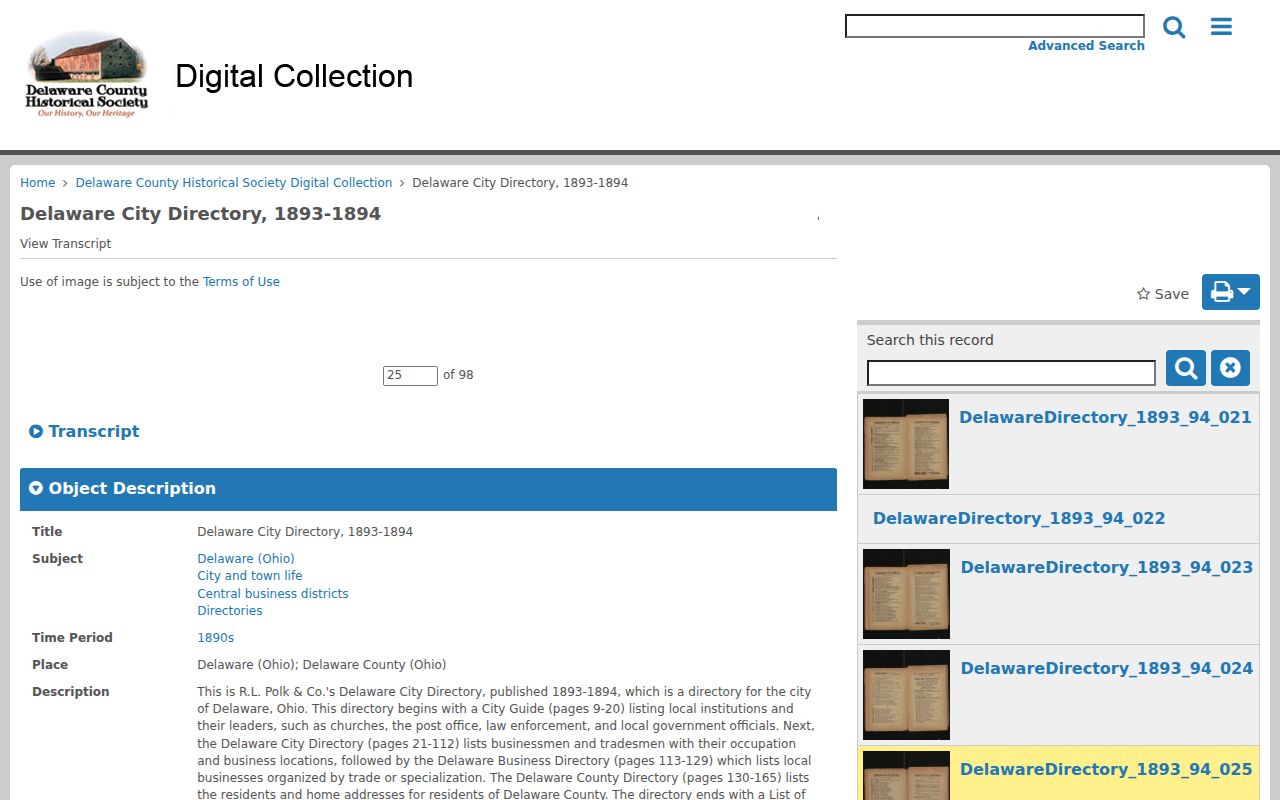
The volume's published description lists a city guide, business and trade sections, a county directory with resident home addresses, an Ohio post-office list, and advertisements. Each section offers different clues. The same name can appear twice with different details. Ohio Memory's 1905-06 Delaware directory is another digitized volume with a street guide.
Street descriptions help locate a historic setting. Match them to an older map or census entry before trusting a modern road number. Roads were renumbered. A current number may not match at all.
Note: A scan may omit a person because the book was selective, the household moved, or the name was printed under another spelling.
Reading a Scioto Township Directory Entry
The 1893-94 Polk volume mixes several kinds of entries. It opens with a city guide. Then come people and businesses with occupation or business location, followed by businesses arranged by specialty. Later pages list Delaware County residents with home addresses. Copy a city directory result exactly as printed, punctuation and initials included, before comparing it with other records.
Local books vary in what they record. Read the title page and abbreviation key in the exact volume before assigning meaning to any mark. Guessing an abbreviation invites errors that spread through the whole family file.
| Name | Copy the printed spelling, initials, and any nearby variant before searching another source. |
|---|---|
| Occupation or trade | The digitized Polk description confirms businesspeople and tradespeople, plus business locations. |
| Address or place clue | A county-resident entry can supply a home address; a business section may instead supply a work location. |
| Street guide | The 1905-06 volume includes street descriptions that can help place a historical setting. |
| Printed key | Use the volume's own abbreviation key before interpreting labels or symbols. |
- Householder index
- An alphabetical list centered on the named household contact. Verify whether a particular volume actually has one.
- Criss-cross directory
- An address-ordered directory. No local reverse or criss-cross run has been verified for Scioto Township, so request a specific shelf check.
- Abbreviation key
- The printed explanation of the volume's shortened words and marks. It controls how an entry should be read.
Scioto Township City Directory Geography
Ostrander is an incorporated Village inside Scioto Township. It is not another name for the whole township. Older material may use either place, a rural route, or the larger Delaware collection. Record the place label exactly, then determine whether the underlying record belongs to the township, Village, county, or state before requesting more material.
The township's rural character shapes what survives. Farm households often appear nowhere in a city directory. A landholder map, tax duplicate, deed description, cemetery record, or newspaper item may place them more easily. The 1866 county atlas is a strong substitute. Its Scioto Township map names landholders, residences and farms, schools, churches, cemeteries, and an advertising directory.
Delaware County Memory's 1866 Scioto Township atlas is a source for that place-and-landholder context.
Use the atlas to form a dated place hypothesis. Then test it against a directory volume, census household, or recorded instrument. The atlas is not a title record.
Scioto Township Directory Research Desks
The Local History Room sits at the Main Library. It holds Delaware City and Delaware County directories. Cemetery and tombstone material, county atlases, church histories, census microfilm and indices, yearbooks, and family histories round out the shelves. Delaware Gazette microfilm starts in 1821. Everything is for in-library use.
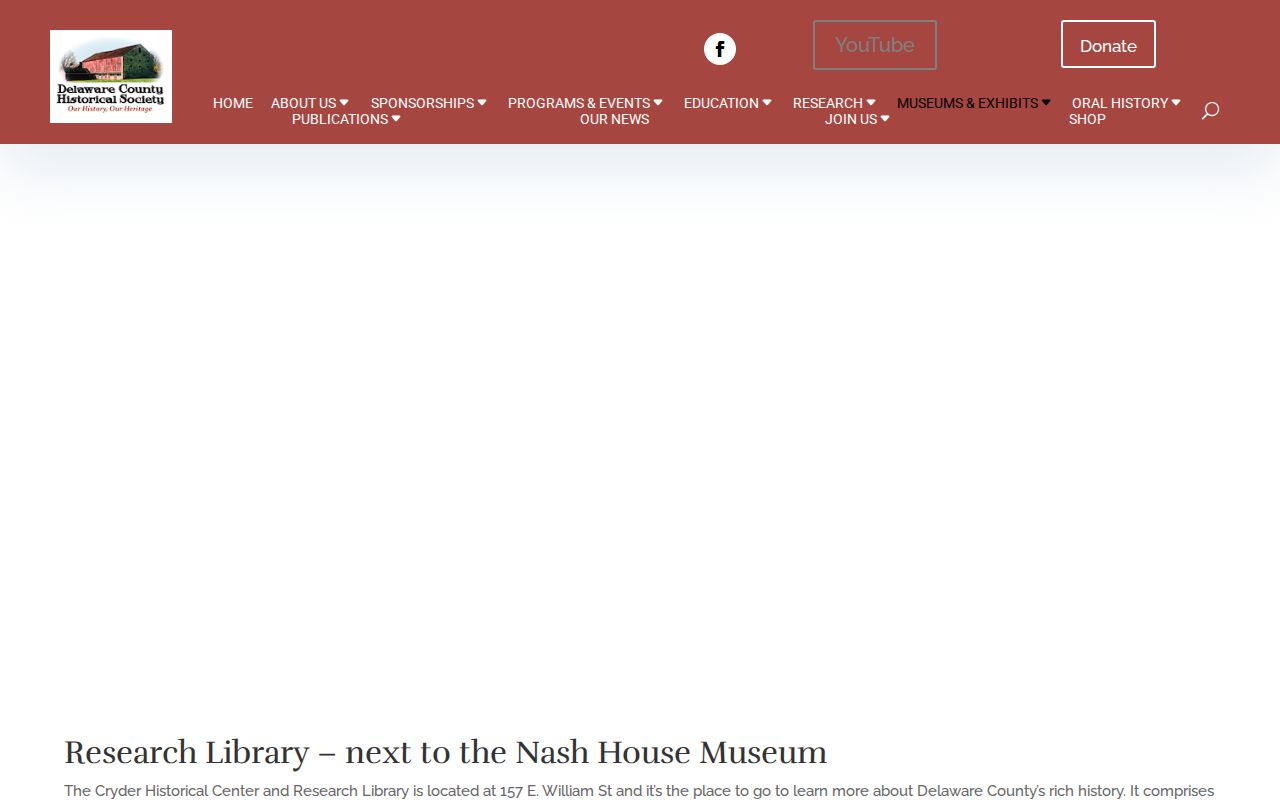
The Delaware County Genealogical Society works in that room and can identify the right shelf or catalog volume. Cryder Research Library is a separate destination at 157 E. William Street, holding county newspapers, obituary archives, maps and atlases, Delaware City and rural-route directories, and Delaware school and Ohio Wesleyan yearbooks. Sunday hours are 2-5; Wednesday 10-noon and 1-5. Other times come by appointment. The librarian can be reached at 740-369-3831 ext. 2 or librarian@delawareohiohistory.org.
Cryder Research Library's collection page identifies the historical materials available for a targeted directory search.
Preparation makes a research desk visit pay off. Bring a surname, a likely place label, and a narrow date range. Ask whether the shelf holds a city, county, rural-route, or address-ordered volume for those years, and note the call number or reel used.
Note: The Local History Room answers its phone at 740-362-3861, and Cryder's librarian handles focused historical-collection questions.
Scioto Township Archive Companions
An old directory entry proves far more once it sits beside another dated local source. The Local History Room at the District Library collects exactly that kind of company. Its shelves hold census microfilm and indices, county cemetery and tombstone material, church histories, yearbooks, local family histories, maps and atlases, the Bouic Index, and Delaware Gazette microfilm. The newspaper run starts in 1821. It runs straight through to the present. That stretch can bridge the gap between a printed entry and a later family event.
Delaware County Memory adds free digital material. The collection includes township tax duplicates for 1827-28, marriage record volume 1 for 1835-45, transcribed wills for 1812-35, digitized newspapers, and the 1866 Scioto Township atlas. Each item answers a different question. A tax roll can place a township-era name. A will may name an estate connection. A map can supply a rural place clue, though none of these works as a full list of township residents.
| Census microfilm | Use the Local History Room to compare a printed name with a released household enumeration. |
|---|---|
| Gazette microfilm | Search dated obituaries, social notices, legal notices, and place references around a known family event. |
| Tax duplicates | Use the verified 1827-28 township set as early tax evidence, not a proof of an address. |
| Wills and marriages | Use the digitized county materials to test family or estate connections against their dates. |
Label every note with its source type. A name in a newspaper notice, a taxpayer, a recorded party, and a member of a census household may all be one person. The record roles are not interchangeable, though.
Tracing Scioto Township City Directories
Dating every directory entry keeps a family trail honest. People move. They die, get omitted, or reappear under a changed spelling between one publication and the next. Pair the city directory with the nearest released federal census. That census becomes public 72 years after enumeration. Then use an obituary, probate item, cemetery contact, or deed trail. It tests what happened in the gap.
- Search an available directory volume for the surname, business, village, or rural-route clue and record the exact page.
- Write down only details actually printed, such as spelling, occupation, address, business location, or family clue.
- Check the next available directory and its street guide, if present, for a move or a new spelling.
- Compare the dated entry with the appropriate released census household and local newspaper notices.
- Use probate, cemetery, property, or obituary material to test an event between directory volumes.
The Mendenhall Files at Cryder follow Delaware County property transfers from 1800 through 1891, and they earn their keep once a family question becomes a property question. Treat the files as a companion. They never replace the Recorder's own deed evidence.
Scioto Township Directory Timeline Clues
Directory work fits a wider county record timeline. Delaware County commissioner journals begin in 1808, and the county road books run from 1808 through 1941. Atlas editions appear for 1849, 1866, 1875, and 1908. The eleven digitized directory volumes span 1859 through 1922. Each date is a comparison point, not proof of unbroken annual coverage.
| 1808 | County commissioner journals begin, providing early government and road context at the Records Center. |
|---|---|
| 1859-1922 | Eleven early Delaware directories were digitized; the project is not proof of a yearly township run. |
| 1866 | The county atlas offers a Scioto Township landholder and place snapshot. |
| 1821 to today | Local newspaper microfilm supplies dated notices that can bridge gaps between books. |
The Delaware County Records Center serves as the archival fallback for older county government material. Use its public research area. A staff-assisted request works best when it is specific rather than a sweep for every record tied to one surname.